
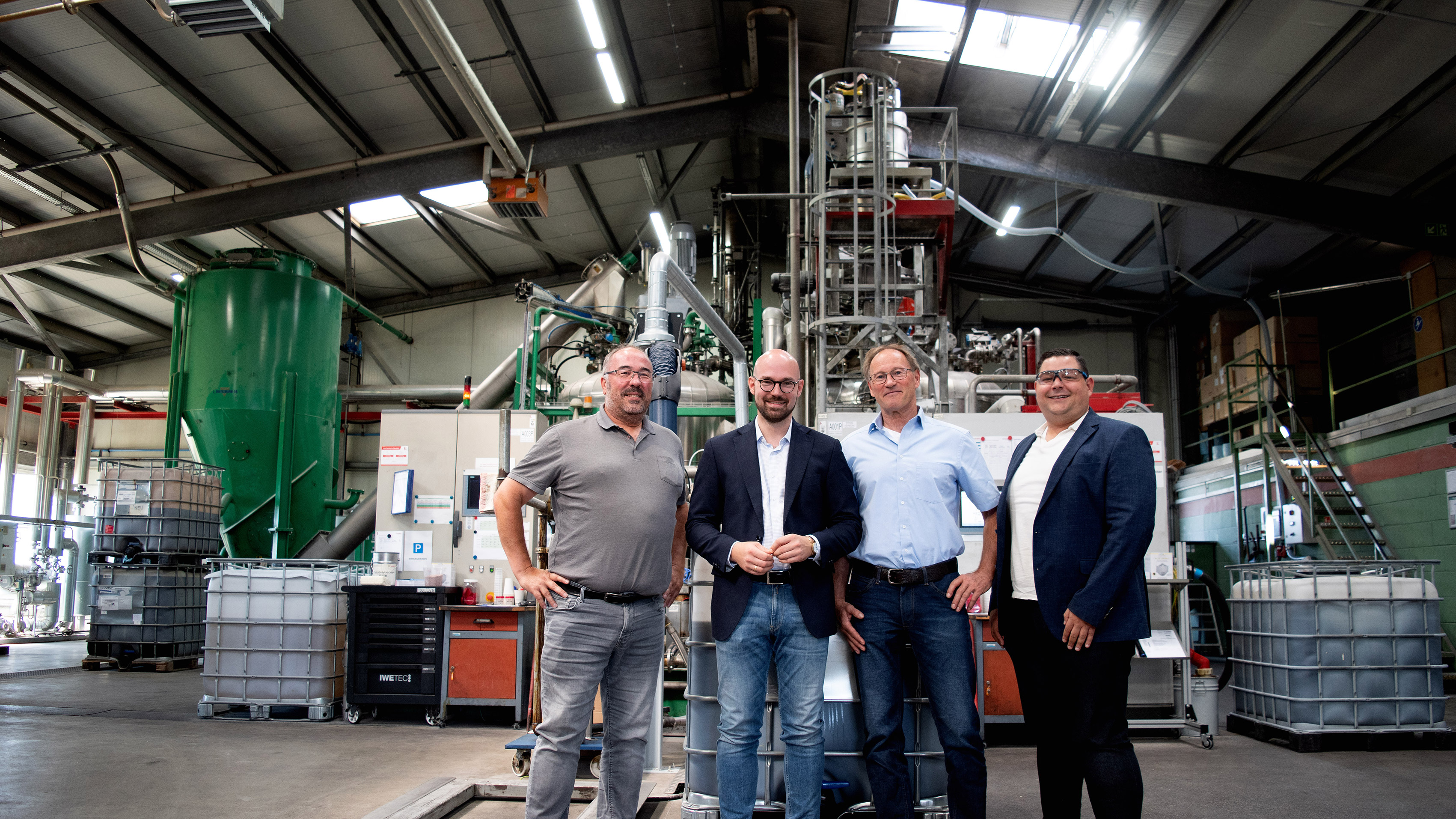
Driving the circular economy forward (from left to right): Marco Werth (Director Business Center Recycling Polyols, RAMPF Advanced Polymers); Member of the German Bundestag Florian Bilic; Michael Kugler (Director of Sustainability, RAMPF Advanced Polymers); and Alexander Ege (CTO, RAMPF Advanced Polymers).
Advancing the Circular Economy: Member of the German Bundestag Florian Bilic Visits RAMPF in Pirmasens
Key Takeaways
- During his visit to RAMPF in Pirmasens, Bundestag member Florian Bilic emphasizes the growing importance of the circular economy in strengthening raw material security, reducing energy dependencies, advancing climate protection, and boosting Germany’s competitiveness and innovative capacity.
- Viable recycling quotas and effective incentive mechanisms can play a key role in increasing demand for sustainable raw materials and accelerating the scale-up of chemical recycling.
- With its chemical recycling technology, RAMPF converts polyurethane and PET waste into high-quality recycled polyols for new applications. Compared to petroleum-based systems, these materials reduce CO₂ emissions by more than 40 percent while offering clear advantages over other processes.
Putting circular economy into practice: Innovative chemical recycling technologies for plastic waste and pragmatic policy frameworks were the focus of a visit by Florian Bilic, Member of the German Bundestag for the Pirmasens constituency and rapporteur on circular economy affairs for the CDU/CSU parliamentary group, to RAMPF in Pirmasens-Gersbach.
The circular economy is no longer a vision for the future, but an ecological and economic imperative. To succeed, it must benefit both the environment and the companies investing in innovative technologies that transform waste into valuable raw materials and high-performance products,
emphasized Florian Bilic at the start of his visit.
On the one hand, increasing raw material scarcity, global dependencies on raw materials and energy, climate change, and growing environmental pollution make industrial waste recovery more important than ever.
On the other, strengthening the circular economy is also an opportunity to enhance Germany’s competitiveness as an industrial location. With their technological expertise and innovative strength, our companies can become pioneers in a growing future market through advanced recycling technologies, creating jobs and generating sustainable economic value,
Florian Bilic pointed out.
Creating Value Instead of Waste: Chemical Recycling of Plastic Waste
For more than 30 years, the RAMPF Group has been developing technologies for the upcycling of plastic waste at its Pirmasens site. The company operates two of Europe’s largest multifunctional recycling plants, where polyurethane and PET waste are converted through a proprietary solvolysis process into customized recycled polyols. These high-quality raw materials are then used in the manufacture of new polyurethane products.
Polyols are a key component of polyurethanes and typically derived from crude oil. Our recycled polyols are recovered from polyurethane and PET waste and used as high-quality raw materials for new polyurethane applications, including insulation materials and tooling boards. Compared with virgin polyols, our systems reduce CO₂ emissions by more than 40 percent and deliver significant environmental benefits over other technologies, helping to advance a truly circular economy,
explained Alexander Ege, Chief Technology Officer (CTO) of RAMPF Advanced Polymers.
Another key focus is the integration of renewable raw materials such as rapeseed oil and castor oil into polyol production. Through these bio-based solutions, RAMPF provides the polyurethane industry with an additional resource-efficient and environmentally friendly alternative to conventional raw materials.
Recycling Quotas That Work in Practice
Chemical recycling is inherently attractive from an economic perspective because it uses waste as a raw material. To make recycled polyols more competitive, greater market demand, larger production volumes, and effective incentives are needed. As petroleum-based polyols continue to be less expensive, practical and economically viable recycling quotas can play a key role in driving market adoption and supporting the expansion of chemical recycling.
Recycling quotas must strike the right balance between ambition and practicality. Policymakers and industry need to jointly define a technically feasible and economically viable starting point that creates genuine market momentum. As technologies and markets continue to develop positively, the quota can be increased step by step,
said Michael Kugler, Director of Sustainability at RAMPF Advanced Polymers.
The region has a unique opportunity to transform itself from Germany’s traditional shoe capital into a leading center for chemical recycling. This transition can create new industrial jobs and strengthen Pirmasens’ long-term competitiveness. To make this vision a reality, we will continue to advance our technologies. At the same time, supportive regulatory frameworks at both the German and European levels are needed to encourage investment and accelerate the circular economy,
Marco Werth, Director Business Center Recycling Polyols at RAMPF Advanced Polymers, looks to the future of the Pirmasens site with optimism.
Share article:


Press contact: Benjamin Schicker pr@rampf-group.com