Equipment Housings
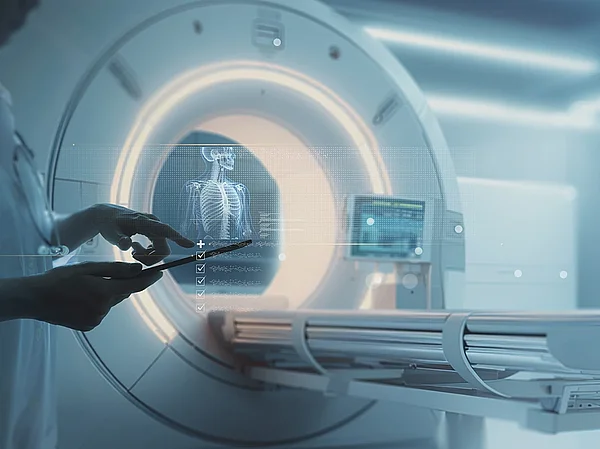
Composite housings protect internal systems, reduce weight, and enable clean, precise exterior designs for medical technology equipment.

Medical Technology
Precision Composite Solutions

Medical technology equipment must meet demanding requirements for precision, durability, cleanability, dimensional stability, and repeatable performance. Components must reduce weight, protect sensitive systems, support moving assemblies, and integrate seamlessly into increasingly compact equipment designs.
At the same time, manufacturers require reliable production processes, consistent quality, and components that perform reliably within complex medical systems.
Advanced composite materials address these challenges by combining low weight, high strength, stiffness, corrosion resistance, dimensional stability, and design flexibility. They enable lightweight, high-performance housings, enclosures, covers, structural components, robotic systems, panels, and other custom medical technology parts while giving engineers greater design freedom.
RAMPF supports medical technology manufacturers from concept through series production with integrated engineering, material selection, tooling, composite manufacturing, finishing, metallization, testing, and subassembly.
Using carbon fiber, fiberglass, and hybrid composite materials, we develop and manufacture precision composite components for equipment housings, enclosures, structural supports, covers, robotic systems, imaging and positioning equipment, and other custom applications.
Our integrated approach delivers lightweight, dimensionally stable, and durable composite solutions with high-quality surface finishes that accelerate product development, simplify production, ensure consistent quality and the efficient delivery of high-performance medical technology equipment.
Carbon fiber composites enable lightweight, high-strength medical components with exceptional stiffness, dimensional stability, and precision. They are ideal for equipment structures, robotic systems, positioning components, housings, and custom assemblies where performance, accuracy, and reliability are critical.
Fiberglass composites can be a practical choice for covers, enclosures, housings, support structures, and other medical technology components where durability, geometry, and production efficiency need to be balanced.
Not every medical technology component requires the same material approach. RAMPF supports material selection based on part function, geometry, weight targets, load requirements, finishing needs, and production volume.
Medical equipment housings and enclosures need to protect internal systems, support clean design, and integrate with surrounding assemblies. Composite materials help reduce weight while supporting complex forms and durable construction.
Composite structural supports are engineered for stiffness, stability, and reduced weight in medical equipment, imaging systems, robotic platforms, and positioning technologies.
RAMPF manufactures composite covers, panels, and access components that support clean finishes, reliable fit, and lightweight construction.
RAMPF’s in-house engineering and tooling capabilities deliver repeatable production, mold accuracy, part consistency, and efficient development.
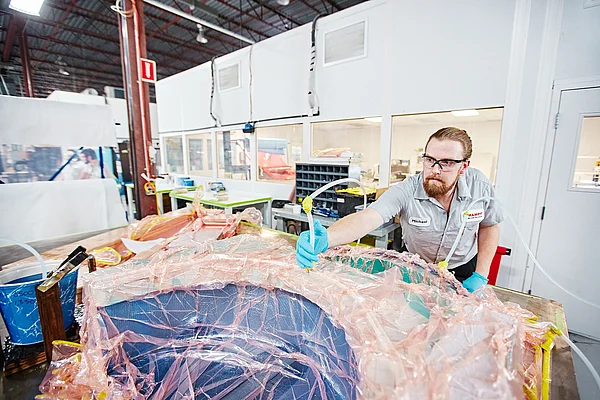
RAMPF’s composite manufacturing capabilities include VARTM and resin infusion, both of which deliver lightweight, strong, repeatable composite parts.
For medical technology components, these processes are suitable for housings, covers, enclosures, supports, panels, and equipment structures where part quality, dimensional control, and production efficiency matter.
Tailored fiber placement, or TFP, allows reinforcement to be placed more precisely based on the part’s design and load requirements.
For medical composite parts, TFP supports efficient reinforcement in specific areas without adding unnecessary material throughout the entire structure.
Hand layup is used for complex composite parts, specialized components, prototypes, lower-volume builds, and applications where careful material placement is required.
Medical technology parts often depend on consistent geometry, reliable fit, and high surface quality. RAMPF supports tooling development, helping manufacturers move from design intent to repeatable production.
RAMPF’s manufacturing capabilities include metallization, finishing, and subassembly. Depending on the application, these capabilities address functional or cosmetic requirements for composite equipment components.
RAMPF provides full subassembly services, helping customers reduce internal assembly steps and simplify integration. For medical technology manufacturers, this is particularly valuable when composite components need to arrive ready for the next stage of production.
Medical technology components often need to satisfy several requirements at once. A part may need to be lightweight, strong, smooth, dimensionally stable, easy to assemble, and compatible with nearby mechanical or electrical systems.
RAMPF supports customers with composite engineering services including FEA, 3D modeling, tooling development, DFM/DFC, process engineering, product design, and process optimization.
This integrated approach helps medical technology teams make practical decisions around:
RAMPF’s quality approach is built on certified processes, rigorous inspections, and continuous improvement, ensuring precision-engineered composites and consistent performance. For medical technology manufacturers, this means components that fit accurately, perform reliably, and deliver repeatable quality across production.
RAMPF develops and manufactures custom composite components that enhance the performance, durability, and design flexibility of medical technology equipment and device-adjacent applications. From structural elements and protective enclosures to precision-engineered functional parts, these solutions help manufacturers achieve reliable performance, consistent quality, and efficient product integration.
Medical technology manufacturers need more than a component supplier. They need an experienced engineering and manufacturing partner that understands how material selection, tooling, process control, finishing, quality, and assembly affect the final part.
RAMPF brings composite engineering, carbon fiber and fiberglass manufacturing, tooling, finishing, testing, and subassembly together under one experienced team, supporting customers from initial concept to production-ready components.
Medical technology manufacturers require components that combine strength, low weight, dimensional stability, durability, and consistent quality. RAMPF develops and manufactures advanced composite solutions tailored to the performance, design, assembly, and production requirements of each application.
From equipment housings and enclosures to structural supports, robotic components, covers, and other custom-engineered parts: RAMPF delivers the engineering expertise, material technologies, and manufacturing capabilities needed to bring complex composite solutions efficiently into series production.
Global Support. Anytime. Anywhere.